Come join our MGa team for the first annual
Day of Service, a day in which parents, teachers, students and advocates
(architects) from around the world will work to make our schools healthier,
more sustainable places to learn. MGer’s
will be out in force in the San Benito, Weslaco, McAllen and PSJA areas. See
you there!
Architects, Multi-disciplinary Design Firm, Educational - Public / Private / Charter, Commercial, Manufacturing, Churches, Theaters, Housing - Public / Private, Master Planning, Interiors -Space Planning, South Texas, Rio Grande Valley, Brownsville, Harlingen, Weslaco, McAllen, Edinburg, Mission, Rio Grande City, Roma, South Padre Island, San Benito, Raymondville, Mercedes, Donna, Pharr, San Juan, Alamo, Hidalgo, La Joya, Cameron / Hidalgo /Starr and Willacy Counties.
Saturday, September 29, 2012
Sunday, September 23, 2012
CEFPI - Day Two
Hector Rene Garcia, Mata-Garcia Architects principal, is attending the Certified Educational Facilities Planners International (CEFP I) World Congress on Educational Environments in San Antonio, Texas this week. The following are summaries of the sessions he attended.
The Best School Ever Made: Beth Hebert, former principal at Crow Island School, Winnetka Public Schools. Hebert reviewed her experience at Crow Island School and how the look and feel of a school matters to students and is deeply connected to their attitudes, behavior and learning. Having toured this school a few years ago, I know first hand what a classroom and a school environment can accomplish. Hebert explored the connection between specific features of classroom and school design that impact student learning beginning with lessons learned from Crow Island School - a national historic landmark and now almost 75 years old. The session also covered (a.) Understanding the importance of collaborative conversation between architects and educators, (b.) Identifying specific design features that enhance student learning, (c.) Exploring how the design of space relates to student attitudes, behaviors and learning, and (d.) Learning specific strategies for engaging students in the design process.
Go Outside to Learn: The Value of Outdoor Learning Environments: Robing R. Randall, ED lab INC. Randall stated that "When present in nature, all senses are stimulated," which is the optimum state of learning, blurring the boundaries between academic learning and creative curiosity. As a mini-ecosystem, the "outdoor classroom" fosters the use of systems thinking and emphasizes the interconnectedness. Through exposure to the intricate web of life, students come to understand that complex natural and societal systems often require holistic rather than linear solutions. In seeking a holistic understanding, outdoor learning lends itself to inter-disciplinary studies employing multiple academic disciplines. Global environmental issues are reflected in microcosm and often lead to service learning projects that emphasize social responsibility. Randall reviewed how she (a.) Uses evidenced based design research to document the value of outdoor learning, (b.) Defines the characteristics and stimuli of the outdoor learning environment, (c.) Dissects examples of projects that support spontaneous and organized learning, and (d.) Discusses future implications to curriculum delivery and environmental responsibility.
Building as a Teaching Tool: Connecting, Curriculum, Culture and the Physical Environment: Stephanie Barr, Institute for the Built Environment, Colorado State University and Craig Schiller, Build to Teach Consulting LLC. This seminar asked the question "How can we design and operate schools which not only save energy, resources and money, but also actively engage and educate students in sustainability? Taking green schools beyond a physical shell, to an active, dynamic green learning environment requires more than just visible green building features. A holistic approach, driven by both educators and building professionals, is needed to integrate sustainability into building design, curriculum, organizational culture and an community at large. Only through this holistic integration is a building truly a teaching tool. Utilizing case studies and recent research, Barr and Schiller defined principles, provided a framework and presented tools for creating a school building that teaches. Also covered were (a.) Understanding the necessity of a whole-school approach and integrating sustainability into educational programs, organizational culture and facility design to create a building that successfully teaches, (b.) Defining common design principles and building components which make successful teaching tools and the methods used to connect building features to learning opportunities, (c.) Exploring "best-case" examples of how school buildings across the country are being used to teach sustainability and (d.) Providing hands-on experience planning a holistic building that teaches.
Saturday, September 22, 2012
CEFPI - Day One
Hector Rene Garcia, Mata-Garcia Architects principal, is attending the Certified Educational Facilities Planners International (CEFP I) World Congress on Educational Environments in San Antonio, Texas this week. The following are summaries of the sessions he attended.
Keynote Speaker: Jason Ryan Dorsey, "The Gen Y Guy" kicked-off the day with his highly energized talk "Crossing the Generational Divide: Leveraging the Power of Generations for your Strategic Advantage. Dorsey noted that for the first time in world history, four different generations are working side by side, with a fifth generation on its way! He went on to state that each generation brings a different perspective, strengths and priorities to the workplace. While it can be a frustrating experience - leaving a voice-mail and getting a text as a reply - can be a strategic opportunity depending on how one responds. Dorsey revealed each generation's workplace mindset and followed up with strategies that drive results across generations.
Connecting the Dots - The New Ecosystem of Pedagogy, Technology and Space: Lennie Scott-Webber, PhD. The session dealt with a behavioral conditioned response method in terms of teaching and learning in a classroom setting - stand and deliver / sit and listen. It was stated that this pedagogical approach no longer works. The pedagogy, technology and space need to be intentionally developed and purposefully integrated in order to deliver on the demand for 21st century learning skills by students, parents and corporations alike. Scott-Webber's research has led her to understand this paradigm shift and she shared the drivers for change, design principles and methods to successfully deliver on this need.
Connecting Students, Creating Futures at Central Campus: James Britt and Elizabeth Erbes of RDG Planning & Design and Bill Good and Julie Rosin of Des Moines Public Schools. A 1916 Model T factory in downtown Des Moines, Iowa has been retooled from building cars to building futures. The Central Campus, a 400,000 square foot high-rise buidling has been continuously evolving to accommodate a unique variety of project based learning programs for students of all ages. Fourth graders immerse themselves in the 2012 presidential campaign, while high school seniors in Marine Biology raise jelly-fish; downtown office employees exercise in the wellness center and enjoy lunch in the student-run Campus Cafe of the Culinary Arts program. Unique spaces and programs have become the catalyst for connection and creation. (a.) We learned about the diverse culture and climate created to serve multi-age learners through project-based programming in a century-old building. (b.) The team showed how to effectively engage an underutilized, existing facility to support and grow a vibrant, connected learning environment. (c.) Rosin and Erbes gave examples of the positive impact of unique programming and high-performance space on students, faculty and community members. In closing, the group helped us understand the benefits of a strong vision and quality management to create dynamic learning spaces for a diverse community.
Des Moines Central Campus serves students from 29
districts and 57 schools, and was originally a 1918 a Ford car factory that has
been converted in recent years to a high-efficiency, regional, K-12 school. The
renovations have included the installation of double-pane glazed windows in
order to increase the availability of natural light and reduce the need for
artificial lighting. High-efficiency water source heat pumps also were
installed in the school, and reduce the need for steam heating. Des Moines Central
Campus has reduced its energy consumption by 28 percent compared to a 2008
baseline, and has reduced its water consumption by 64 percent compared to a
2009 baseline. In this urban setting, students use sustainability concepts to
learn green job skills. Home building
students use recycled materials to turn old bleachers into hardwood flooring.
The aviation program works with the Iowa congressional district to salvage old
jets and helicopters as teaching tools.
A welding program recycled over 43,000 pounds of scrap metal in 2011.
The teacher academy is working toward paperless operations with electronic
portfolios. The culinary arts program installed a grow cart to cultivate herbs
and salad greens, and their new ENERGY STAR dishwasher reduces energy consumption. Animal science students use recycled
materials to create wildlife habitat sculptures. Design students study sustainability
principles and devise constructions that incorporate LEED criteria.
Horticulture students offer their landscaping services throughout the campus.
Technology students’ use of cloud computing reduces energy consumption by over
a third. Central Campus’ Iowa Energy and Sustainability Academy is a two-year
program that teaches sustainability, green technologies, renewable energy, and
conservation. The school nurtures partnerships with University of Northern
Iowa, Siemens, Iowa Department of Natural Resources and the Iowa Energy
Department.
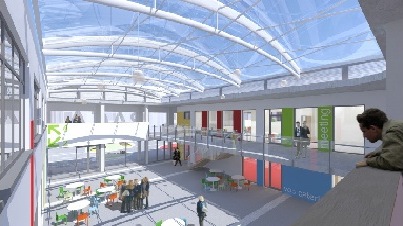
Vision to Reality, through an Integral Approach to School Design: Daniel Plunkett and Matin Coleman - Kilworth Studio Ltd. These Brits presented their take on non-traditional schools with "unique engagement strategies." The project presented was the The Isle of Portland Aldridge Academy.
Thursday, September 20, 2012
Alfresco Weslaco - Tonight!
Our MG'ers will be out in force at the monthly Alfresco Weslaco -
Jazz on the Street! Amazing artists, food, and music - every sense will be energized. Hope to see you there!
Wednesday, September 12, 2012
Engage, Educate & Recycle, K-12 Sustainability Solutions
September 12, 2012, 1:00 PM CDT
Imagine a world where schools
serve as a model of sustainability for their communities, teach their students
to use natural resources responsibly, and empower them with the skills to solve
global environmental problems. Many schools across the country are already
blazing the trail in going green and finding it not as difficult as they
anticipated. Join Waste Management's Carrie Becker, Keep America Beautiful
(KAB)'s Kelly Dennings and Spring ISD's C.G. Cezeaux as they discuss
environmental trends and implications for K-12 schools, share best practices
from exemplary schools and give easy, practical solutions to move your school
along its sustainability journey.
Presented by School Planning & Management’s WEBINARS FOR EDUCATION.
Moderator: Deb Moore, Executive Editor/Publisher, School Planning & Management
Featured Speakers:
Carrie
Becker, Director of Education
Sales, Waste Management;
Kelly Dennings, Director
of Recycling Programs and Services, Keep
America Beautiful; C.G. Cezeaux Director of Operations, Spring Independent School District, Houston, TX.
Saturday, September 8, 2012
CineSol Film Festival is a showcase festival that makes its way across the
Rio Grande Valley, celebrating achievement in the art of film-making. CineSol is dedicated to furthering the art, craft and business of screenwriters
and filmmakers and recognizing their artistic contributions. CineSol supports
the work of aspiring and established filmmakers by enhancing public awareness of
their artistic endeavors and by encouraging dynamic and long-lasting community
alliances. Mata-Garcia Architects' own Mario Garza, Jr. is on the festivals' board and several M-Gers will be on-hand to view the films. Join us! (Saturday/Sunday, September 8th/9th in Harlingen and Saturday/Sunday, September 15th/16th in Edinburg.)
Monday, August 27, 2012
Lecture Series: Gil Penalosa of 8-80
LRGV-AIA reports that: Gil Peñalosa,
executive director of the Canadian non-profit 8-80 and
internationally renowned city advisor and active public spaces advocate, will
speak to the Brownsville community August 28 and 30 as part of the Building a
Vibrant Brownsville lecture series. Mr. Penalosa will share his knowledge and
experience in designing parks, streets, and open spaces to foster improved
health, economic development, and a greener environment.
Mr. Peñalosa, the third speaker of the
Building a Vibrant Brownsville series, will give a special presentation for the
Spanish-speaking community on August 28 at the Camille Playhouse at
5:30 p.m. His keynote address (English) is scheduled for August 30 at the Science, Engineering and Technology Building on the UTB and TSC campus at 7:00 p.m. Both
lectures are free and open to the general public.
In Edinburg: Mr. Peñalosa's main focus regards economic
development and community health initiative for local communities and is
an advocate for people-friendly development of cities and safety. Peñalosa will speak at on August
29, 2012: 1. Edinburg Summit - Wednesday, August 29, 2012, 3:00 p.m, open to the general public., Edinburg City Hall, Council Chamber, 415 W. University Drive, Edinburg, Texas 2. Community Banquet: 5:30 registration, 6:00 p.m. dinner. $20, Edinburg Consolidated Independent School District, Administrative Boardroom, 2nd Floor, 411 N. 8th St,. Edinburg, Texas. For more information & banquet tickets, please contact Ann Millard at (956)
668-6320 or Thalia Morin at (956)-322-1940 thaliamorin@gmail.com
MG'er Christopher R. Collins, Architect, has
been selected to teach two architecture courses at Texas Southmost College
School of Architecture. Chris will teach History of Architecture I and II. (The course surveys painting, sculpture,
architecture and the minor arts from pre-historic times to present with
emphasis on the relationship of culture, geography, environment and materials
to the method of construction.) and Architectural Technology I and II. (This
course introduces students to construction materials, methods, and their
applications with an emphasis on common building materials: wood, masonry,
concrete and metals. Students study building envelope performance and issues of
sustainability as well as the mechanical and electrical systems and their
relationship to the structural system.) Chris will remain with Mata-Garcia
Architects and head our Brownsville office and public relations.
Congratulations!
Sunday, August 5, 2012
Parish Hall
The Diocese of Brownsville has given approval for Mata-Garcia Architects LLP to commence work on the Construction Document Phase for the San Cristobal Magallanes y Companeros Parish Hall. The Master Plan, at Sharyland Plantation, calls for a parish hall (Phase 1), a parish church (Phase 2), a chapel/columbarium (Phase 3) and a parish school/rectory (Phase 4). We look forward to working with Father Ignacio and his Parish Council on this long awaited project. Construction is due to start November 2012.
The west elevation uses brick detailing from the historical Oblate Novitiate at La Lomita on the entry portal and wainscot. Cementitious panels, a continuous clerestory and metal tube arches complete the contempory twist on the historical elements.
The Master Plan uses a courtyard to provide a communal space for the complex; the parish church (left), the parish school/office/store (center) and parish hall (right). The parish rectory is at the lower right corner of the property.Parking will be located off of Santa Ingracia Road.
Interior and exterior sketches of the proposed parish hall.
Tuesday, July 24, 2012
Tuesday Talks: Marvin Windows
Fiberglass Composites in the Window and Door Industry
Maribel
Zimmerman, Architectural Representative for Marvin Windows and
Doors offered this continuing education program to help our staff understand how fiberglass, a composite material, provides superior and sustainable performance. The program explained the pultrusion process and its environmental impact and how it explores the characteristics and thermal properties of fiberglass. Thanks to Maribel for an excellent program!
Thursday, July 12, 2012
Mr. Geodesic Dome
Today is the birthday of geodesic dome designer, Buckminster Fuller. This Thursday, July 12th marks the 107th anniversary of the famed architect and author.
Wednesday, July 11, 2012
Lighting Seminars
Hector Rene Garcia (Architect/Partner) and Christopher R. Collins (Architect) of Mata-Garcia Architects LLP attended the LED Lighting and Lighting Controls Roadshow in San Antonio on July 11, 2012. The event was sponsored by our friends at Spectrum Lighting Inc. at the Center for Architecture at the Pearl.
Seminars Presented:
INTELLIGENT LIGHTING FOR EXTERIOR SPACES: by Mark Sheppard. This presentation covered outdoor lighting codes and practices. It also identified the pros and cons of outdoor sources LED, HID, etc.; and showed how controls can affect and compliment outdoor projects.
LED LIGHTING EDUCATION FOR SPECIFIERS: by Tom Scott. This program gave us an overview of factors related to effective lighting design using Solid State Lighting. Attention was given to the advantages of this new technology in architectural and general lighting applications as well as the science of LEDs and how this new technology can be used to provide a superior energy saving solution in the lit environment without compromising a quality lighting design.
DAYLIGHT HARVESTING LIGHTING CONTROL APPLICATIONS: by Richard Hormuth. This exciting program delivered an overview of daylight harvesting. Attention was given to terminology, applications, zoning, and circuiting, daylight entering the space, photo-sensors, open and closed loop, and electrical light reduction.
THE POWER OF DIGITAL LIGHTING AND CONTROLS – SMART AND SIMPLE: by Bill Ballweg. This dynamic speaker offered a fundamental overview of the characteristics of LED digital lighting. Ballweg addressed the quality of illumination, how to create a digital lighting system, the long term cost benefits, and how using controls can reduce the carbon footprint.
A big thanks to Spectrum for sponsoring these excellent programs.
Labels:
Seminars
Location:
San Antonio, TX, USA
Subscribe to:
Posts (Atom)


.jpg)

.jpg)