Showing posts with label Elementary Schools. Show all posts

Friday, May 15, 2015

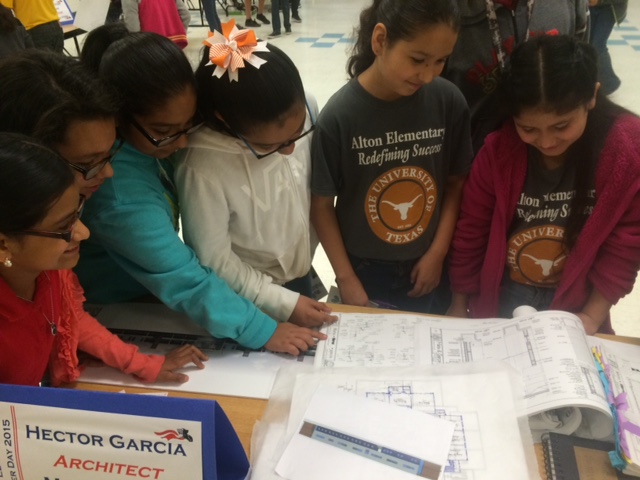
Career Day: Alton Elementary School

MG'er Hector Rene Garcia, Architect, was bombarded with questions by the well prepared students at Alton Elementary School. The students had been schooled on the basics of the profession and then were free to ask their own questions.  It never fails, the first and most frequent question: "How much does an architect make?" Best wishes to these eager students. See you next year!


Thursday, June 13, 2013

We Cherish This Building!


MERCEDES — Mercedes ISD trustees got a look at construction progress in the expansion of North Elementary at a workshop last week.

"We cherish this building," Mercedes Independent School District Superintendent Daniel Treviño said. "It's our newest building, serving first through fifth grades."  A construction crew is building six additional classrooms and Treviño hopes to turn North Elementary into a middle school that serves sixth through eighth grades in 2014. The gym will be turned into a band hall and a new gym will be constructed, he said.

Also Monday, trustees recognized a plaque mounted at the school four years after it was constructed. The plaque, which lists the names of the school board and superintendent on board during the school's construction, first was commissioned in 2009 when the school opened, but it was lost in changes in staffing over the years and only recently resurfaced.

Former Superintendent Walter Watson, who headed the district at the time, was invited to the event as an honored guest. Retired from the district, Watson said he's found himself working with children again, but he still misses Mercedes ISD

Monday, June 3, 2013

5.5 Ways To Turn Your Classroom "GREEN"


As architects, we often get asked by the teachers of the schools we design for help in taking positive steps to save our planet. We enjoy showing how easy it is to do so! Here’s a simple list of items both teachers and students can use to Reduce, Reuse and Recycle.
1. Recycle:  Place paper and plastic recycling boxes in your classroom and promote their use. Students take turns being the recycling monitor, taking responsibility for demonstrating and knowing what is recyclable and what is not. Teachers can minimize the amount of paper used in classrooms, without compromising educational objectives, by going paperless. Writing assignments and testing on computers, posting information on the school website and the use of email, all help limit the use of paper.
2. Plant a Tree: Turn your school grounds into a park! On many of our projects, landscaping is usually left out or deleted from the project scope. The client’s point-of-view being that the school PTA will provide the landscaping. This rarely happens! In a school with 750 kids, the classrooms number about thirty-four. A $250 two-inch caliper tree or shrub, when divided by 22 students per classroom, equals a cost of $11.36 per child per semester (63 cents per week). If a school does this twice a year it would amount to sixty-eight trees and shrubs per year. Trees lower the surrounding temperature, filter air, remove carbon dioxide and provide shade and beauty.  What an impact this would make. There will be plenty of trees to hug on Earth Day!
3. Flip the Switch: Every time you leave your classroom empty, turn-off the lights. While we install motion sensors to activate lights when needed in all of our projects, not all schools have them. Turning off classroom lights cuts carbon emissions by reducing electrical use.
4. Edu-Garden: With a school-wide effort, plan and place the "edu-garden" adjacent to the school cafeteria. You can grow vegetables, for use in school meals, or flowers, for display in administration and library areas. The students are able to taste and see what they grow. An additional step is to take classroom and cafeteria water used in assignments or cooking and using it to water the plants.
5. Let the Daylight In: It never fails! During programming sessions, teachers always ask that their classrooms have plenty of windows; once they occupy the space the windows are covered with construction paper, blinds or curtains. We go to great lengths to ensure that only daylight, and not direct sunlight, enters the classrooms. While there will be times when a teacher needs to control the view, there are plenty of teaching moments that can occur by keeping the blinds open – changes in weather, birds building nests, the movement of wind through tree and shrubs, etc. In addition, studies have shown that an aggressive daylighting program can reduce electrical loads by up to 30 percent, increase student performance by 20 % and reduce absenteeism by 50 %.  
5.5 Power Down: Classrooms are empty three periods a day; conference period, lunch period and planning period.  Though teachers my place classroom computers on shut-down mode, they still pull electricity. It is best to completely shut down computers, chargers and printers,   and un-plug them from the walls during these periods and after school hours as well.
Hector Rene Garcia, Architect / Partner - Mata+Garcia Architects LLP

Thursday, March 28, 2013

Throw-back Thursday: Perez Elementary Library


While in Brownsville the other day, I drove past two projects that we designed for the Brownsville Independent School District four years ago. It was good to see that the school maintenance staff has done an excellent job of maintaining the facility as well as the grounds.

Thursday, January 24, 2013

Vanguard Academy - Update

The foundation has been poured for this 32,000 sq. ft. elementary school. The general contractor, OG Construction, now proceeds with the erection of the walls. This is a first for our firm in that it is an all wood-frame school. Completion Date schedule for May 19, 2013.