Showing posts with label Permaculture. Show all posts

Sunday, January 11, 2015

Permaculture Design Movement

MG'er, Hector Rene Garcia, Architect and Partner participated in Part Two of the Permaculture Design Intensive Training with Wayne Weiseman, an international leader in permaculture design, utilizing the teachings of Bill Mollison’s Permaculture Design System.  Garcia achieved a working understanding of ecologically-based planning, site design and management. He was awarded a Permaculture Design Certificate upon completion of this two-part intensive training with a total of 8 days of instruction and design. (Garcia also took part in the Permaculture Design and Education Workshop during the summer of 2014 for a total of 96 hours of hands-on training.)

Wayne Weiseman: An international leader in permaculture design, Weiseman has taught hundreds of Permaculture Design Certificate courses, designed numerous master plans, consulted for educators for curriculum and professional development, taught ecological construction methods, and worked as a contractor, herbalist, renewable energy expert, and farmer over the past thirty years. His new book, Integrated Forest Gardens: The Complete Guide to Polycultures and Plant Guilds in Permaculture Systems was published in August 2014.

Introduction to Permaculture by Bill Mollison. Mollison is considered by many to be the "father of permaculture," an integrated system of design that Mollison co-developed with David Holmgren. It encompasses not only agriculture, horticulture, architecture and ecology, but also economic systems, land access strategies and legal systems for businesses and communities. 

Former MG'er, Mario Garza, Jr. leads his group in mapping-out their design strategy. Mario has been a permaculture activist for many years and grows multiple varieties of fruits and vegetables on his property.


Concept for the Trinity Community Garden project.

Intense design sessions led to innovative results.

Project Goals.

UTPA engineering professor, Jorge Vidal and MG'er Hector Rene Garcia layout the rational for their design as Stephen Johnson and Daniel Vela offer constructive criticism. 

Concept for the Trinity Community Garden project.

Wayne Weiseman reviews team concepts for the Trinity Community Garden project as Hernan Colmenero explains his teams design.

Concept for the Trinity Community Garden project.

UTPA student, Carlos Cortez of Harlingen and his team develop their concept.

Concept for the Trinity Community Gardens project.

Ing. Gerardo González Garibay comments on the mission statement produced by Raziel Flores and Daniel Vela. Gonzalez graduated from the Faculty of Forestry at the University of Nuevo Leon as Forest Engineer in 2013. His first encounter with Permaculture was an introductory course in Tulum, Quintana Roo, learning system design and living philosophy, then deciding to transform his life and stop being a designer / developer of websites and advertising to jump into the development of sustainable systems; Gonzalez obtained his certificate in Permaculture Design (PCD) in Australia taught by Bill Mollison and Geoff Lawton in 2009.  He is currently in charge of the Huerta Project, La Loma Agri-Culture-Permanente, implementing and developing techniques according to the principles of design. Gonzalez seeks to provide tools and knowledge to system design and Permaculture Organic Farming for all those interested, creating Permaculture Mexico (www.permacultura.mx) and organizing information and training to all those who require knowledge.


Concept for the Trinity Community Gardens project.

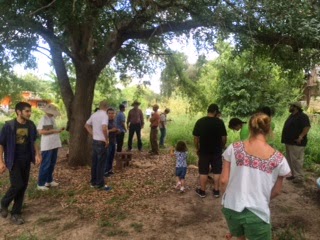
Site of the future Trinity Community Garden.

Concept to be developed for the Trinity Community Garden project.

Carlos Cortez presents his teams concept.

MG'er Hector Rene Garcia, Architect, receiving his Permaculture Design Intensive Training Certificate from Wayne Weiseman.

Sunday, November 2, 2014

Sustainability - Permaculture Design


The University of Texas - Pan American's Office of Sustainability (led by Marianella Franklin and her staff) offered Part One of a two part series - Permaculture Design Intensive Workshop - October 30th through November 2nd.  Mata+Garcia's own Hector Rene Garcia attended this fascinating workshop.

The course covered sustainable living systems for a wide variety of landscapes and climates. It included the application of permaculture principles to food production, home design & construction, energy conservation and generation, and explored the social and economic structures that support a culture that cares for the planet and all its inhabitants. Part I: October 30th to November 2nd, 2014. Part II: January 8th to 12th, 2015.

Topics included in the first workshop were:  Permaculture Ethics and Principles; Observation and Pattern Understanding; Concepts, Themes and Methods of Design; Climate; Landform and Earthworks; Measuring Tools, The Backyard Farmer; Water  & Keyline, Access and Circulation; Vegetation & Wildlife; Plants, Gardening and Farming; Seed Saving; Plant Propagation, Grafting; Gardening & Farming Systems; Plants and Trees; Plant Walk, Plant Guilds; Health use of Animals in Permaculture Systems. 

The funding for this workshop was provided by an anonymous donor. Many thanks to the foundation and the Office of Sustainability for offering this workshop, course material and meals at no cost to the attendees. Garcia said: "Everything was top notch and I met some incredible people that are practicing a sustainable lifestyle right here in the Rio Grande Valley."


Thursday, July 10, 2014

Permaculture Leaders


I had the pleasure of meeting these gentlemen at the UTPA Permaculture Design & Education Workshop, held July 7th - 10th at various RGV locations.  (Information is from their websites.) They are (left to right):

Ing. Gerardo González Garibay

Gonzalez graduated from the Faculty of Forestry at the University of Nuevo Leon as Forest Engineer in 2013. His first encounter with Permaculture was an introductory course in Tulum, Quintana Roo, learning system design and living philosophy, then deciding to transform his life and stop being a designer / developer of websites and advertising to jump into the development of sustainable systems; Gonzalez obtained his certificate in Permaculture Design (PCD) in Australia by Bill Mollison and Geoff Lawton in 2009.  He is currently in charge of the Huerta Project, La Loma Agri-Culture-Permanente, implementing and developing techniques according to the principles of design. Gonzalez seeks to provide tools and knowledge to system design and Permaculture Organic Farming for all those interested, creating Permaculture Mexico (www.permacultura.mx) and organizing information and training to all those who require knowledge.
Wayne Weiseman
An international leader in permaculture design, Weiseman has taught hundreds of Permaculture Design Certificate courses, designed numerous master plans, consulted for educators for curriculum and professional development, taught ecological construction methods, and worked as a contractor, herbalist, renewable energy expert, and farmer over the past thirty years. His new book, Integrated Forest Gardens: The Complete Guide to Polycultures and Plant Guilds in Permaculture Systems will be published August 2014.

Ing. José Gómez Dib 

(Designer, consultant, instructor, translator, representative)  Studies:  May 2014 Regenerative Agriculture and Living Design Course (RAD), taught by Darren Doherty, Muskerry, Australia; July 2012 - Internship Permaculture, Permaculture Farmstay Perak, Lenggong, Malaysia; February 2012 - construction Superadobe Workshop , taught by  Cal Earth Institute , Hesperia, California. October 2009 - Permaculture Design Certificate (PDC Permaculture Design Certificate) , given by Bill Mollison and Geoff Lawton , Melbourne, Australia. November 2008 - University of Queensland. Bachelor of Information Technology.  Collaborating with Walter Pty Alchemy – New Zealand – worldwide leader in aquaculture systems, biogas and algal production; collaborating with Gaiacraft (www.gaiacraft.com) – Canada – development of techniques and educational programs for sustainability and permaculture.

Permaculture Design/Education: Community Gardens

Designing a Community Garden (Part 1):  Leo Pena Placita Park, Mission, Texas.

Our host this morning, Ray Perez, has the City of Mission's backing in his quest to possibly turn the amphitheater section of the park into a permaculture community garden. While Perez has yet to start formal planning, leading to a presentation to the city commission, he asked for ideas with which to start the planning process from those in attendance. Hector Rene Garcia, Architect and Partner, of Mata+Garcia Architects offered to produce the graphics needed to get the project approved.

 Ray Perez talks about his vision for a community garden in downtown Mission. He asked attendees about the best way to treat ground level fill, how to reduce weeds and provide nutrients, good places to get decent soil/mulch, ideas for plants that would do well in this terraced setting, noting a need for plant color and typical plant  types for hummingbirds and butterflies.

A view of the amphitheater stage, center, with both semi-circular (west) and elliptical (east) seating levels.

It was suggested that Perez propose the community garden on the terraced elliptical portion of the amphitheater and leave the semi-circular portion as functioning amphitheater seating for community events.

Designing a Community Garden (Part 2): Trinity Community Garden - Pharr, Texas

Our final stop was at 210 West Caffery (Bluebonnet corner), a lot being developed as a community garden by Alice Lee Williams Penrod, Steven Johnson and Virginia Costilla.  

The group has planted lab-lab in preparing the soil for the future community garden.  The goals are to have "anchor" families that are dedicated to permaculture as a part of life and diet and taking care of self and family. The group hopes to have corporate sponsors for each family with a community harvest, followed by a potluck supper, after each season.

It was suggested that a portion of the property use native plants as a way to attract butterflies and birds.

The UTPA Permaculture Design and Education Workshop close with yet another outstanding meal from Empanadas Argentinas, Sara Alicia Larronde, a permaculture enthusiast as well!

Wednesday, July 9, 2014

Permaculture Workshop: Edcouch-Elsa/Harlingen

Building Communities in the Ecological Epoch: 400 Adkins Street, Edcouch, Texas.

This morning we started off in Edcouch, at a subdivision project undertaken by Proyecto Azteca Inc., a self-housing program adapted to the colonia tradition of owner-built homes.  While Proyecto Azteca usually works on individual homes in colonias, this subdivision is the first time the organization tackles a complete neighborhood. The project will be the first LEED (Leadership in Energy and Environmental Design) Silver subdivision south of Austin.

Ann Williams Cass, Executive Director of Proyecto Azteca noted that once completed, the neighborhood will be home to 32 families, with hike and bike trails, a community center and a park.

The families are required to put in 550 "sweat equity" working hours into building their homes as well as taking classes on sustainable living, financial education, home repair, organic gardening, budgeting and building skills as a trade-off for living in the neighborhood.

The LEED Silver homes line the streets of Dolores Huerta and Rebecca 
Flores, longtime leaders of the United Farm Workers.

With 3,800 families on waiting lists, this particular neighborhood will 
house 32 families in 2 bedroom/2 bath (1,000 SF), 3 bedroom/2 bath
(1,200 SF) and 4 bedroom/2 bath (1,400 SF) homes. The homes were 
built with Insulated Concrete Forms (ICF) and metal roofs. All of the 
homes have rainwater harvesting and a few are fitted with solar panels.

Wayne Weiseman stated that he would like to see the families garden individually rather than as a community. He said the families will be able to see their own money "free-up", money that they can see in their own pockets. Noting that good leadership is necessary, Weiseman said it would occur little by little, common interests, community interests, seeing what is marketable. Refering to the learning of skills, Weiseman said "It starts at the back door."

Saying he was totally into the project; Weiseman closed by asking, "What inspires you and how do you facilitate that?"

Further information on Proyecto Azteca can be found at: www.proyectoazteca.org

The Llano Grande Center for Research and Development, Elsa, Texas.

The center is a non-profit that works to revitalize the local community through its youth.  Its goals are to create access to higher education, engaging students in community change initiatives and developing leadership that respects local history and culture.

The center's multi-tasked director, Orlando Salinas, presented the organization's vision to create an organic demonstration farm along with the local school district (Edcouch-Elsa ISD). Salinas led a tour of the property as Weisemen and workshop attendees provided suggestions on how to best utilize the property.

Orlando Salinas, Llano Grande Center Director give workshop attendees 
a tour of the property where the goal is to build an organic demonstration
farm for local public school student to learn about permaculture principles.

Salinas has done an initial layout of the property which will start with a 
reservoir on the west end and extend to the eastern edge with a mixture
of plot sizes and crop plantings.

Further information on the Llano Grande Center can be found at: www.llanogrande.org

Homestead Permaculture:  Cortez Property, 40 Acres West of Harlingen

Carlos Cortez, an Agroecology student at the University of Texas Pan American, gave us a tour of his family's property and how he plans to use the 40 acres, with complete backing from his family, to practice permaculture.  Cortez said "I want to restore the land and make it productive again."


Carlos Cortez descibes how he plans to practice permaculture on his 
family's property west of Harlingen.  The UTPA student has ambitious 
plans but plans to start with a small plot and expand from there.

Cortez's initial planting is a vegetable crop circle from which he will
expand to surrounding circles for companion planting.

Cortez stands next to his composting area; the property extends to 
the line of palm trees in the background.

Permaculture and Farming
Yahweh's All Natural Farm & Garden, 19741 Morris Road, Harlingen, Texas

Our final stop was at the Yahweh's All Natural Farm and Garden in Harlingen.  Owned and managed by Saul and Diana Padilla for the past ten years producing organically grown seasonal fruits and vegetables. There are also pecan, orange, grapefruit and peach trees on the property. The Padilla's also offer an sophisticated alternative for raising livestock by working with nature rather than against it.  They offer pasture and free range chickens, goats, rabbits and farm fresh eggs.

Diana Padilla leads a tour of her farm's various fruit trees.

Among the trees on the property are: pecan, orange, 
grapefruit, banana and peach trees

Bananas hang from the tree.

 The Padilla's have two green houses; one that they built (shown) 
and one that they bought.

 A line of bamboo acts as a windbreak for the citrus trees.

Organically fed chickens....

....and livestock.

Asparagus vegetable plants in the community garden.

Padilla asked Weiseman what his thoughts were regarding Yahweh's Farm and what she and her husband are striving for, he said one word, "Exquisite!"

Kate McSwain, co-founder with the Padilla's of the Hope Project for Small Farm Sustainability, spoke about their goal to renovate the existing farm house and acreage into public farm plots - 36 plots at 20'x20' each - and a farmers market store with a commercial kitchen.  Coolers will be available for local growers to store their produce.  McSwain said that they intend to be "economically sound and ecologically viable."

Additional information on Yahweh's Farms can be found at: www.yahwehsallnaturalfarm.com

Drawings for the HOPE Project can be found at:
www.behance.net/gallery/3120693/HOPE-for-Sustainable-Small-Farms-Project

Tuesday, July 8, 2014

Permaculture Workshop: Weslaco / Alamo

Today's workshop began with a talk by Wayne Weiseman in the workroom of the Valley Nature Center in Weslaco.  Weiseman discussed UDSA planting zones and the possible use of plant material from adjacent zones; the maintenance and management of permaculture projects; the use of solar food driers; a common-sense approach to cooling a house; the finding of five functions for each plant in use in one's project(s); and functional relationships versus stacking relationships.  Weiseman also recommended viewing "Plants for a Future" at pfaf.org.

Marianella Franklin, Director of Sustainability at the 
University of Texas - Pan American, introduces workshop
speaker Wayne Weiseman.

Restoring Native Habitat by Re-designing Human Communities:  We then took a tour of the Valley Nature Center (VNC), located at 301 South Border Avenue, Weslaco, Texas. Their website states the following: Our Mission is "to provide educational opportunities and to foster appreciation and understanding of the Lower Rio Grande Valley's unique natural communities of flora and fauna." 


The VNC is an 6 acre park that is home to a wide variety of the LRGV's native plants and animals. Many plants were transplanted during the past 25 years to this protected area from sites which were slated for development. There is an ongoing effort to enhance the plant diversity of the park. This aim is for protection of local plant species diversity as well as to make diverse food and habitat available for resident and migratory wildlife. By strolling the 1 mile of trails of the Nature Park, one may examine plant species native to such diverse areas as the Sabal Palm Grove, Arroyo Colorado Brush, the Barretal, Coastal Lomas and the Chihuahuan Thorn Forest.


Wander around our trails and you'll why Malachite and Pixie butterflies, Plain Chachalacas, Great Kiskadees, Buff-bellied Hummingbirds, Texas Tortoises, Eastern Cottontail Rabbits and several lizard and amphibian species can all be seen here. The park is a wonderful natural oasis in the middle of the city.

Urban Permaculture Design:  Visit to 1015 West 6th Street, Weslaco, Texas; the home and on-going permaculture project of Daniel Vela and Alison Fjerstad along with their friend and on-site resident Anthony Santiago. Vela, Fjerstad and Santiago, all 23 years old, have been working on their one-acre property for two years.  Each one provided detailed information on their work thus far, what has been successful and what has failed. The property has been grandfathered-in and will allow them to continue their work along with keeping the three individual residences and in the future some type of livestock.  The intent is to use the main residence, built in 1934, as a learning center - both for the permaculture work on-going and for holistic life enhancements.

Workshop attendees gather in the living room of the 1934 house to
discuss ideas that Vela/Fjerstad/Santiago can incorporate into
their on-going permaculture project

Alison Fjerstad and Daniel Vela discuss the ideas behind the banana
circle they planted near the front entry to their home.  It was suggested
by one attendee that the banana circle be moved to the southeast 
corner of the house so that the house itself can protect the plants
during the cold season.

Daniel Vela demonstrated how a fallen tree, left in-place
and then reclaimed by nature with the micro-system
that has developed around the tree trunk.

After a tour of the property, both Weiseman and workshop attendees provided Vela, Fjerstad and Santiago multiple ideas to implement and/or expand on.  The session was a pleasant surprise; meeting three 23 year-olds working a day job and  living frugally to provide funds for their passion; a permaculture project that will easily take a minimum of ten years for it to be fully realized.  

Anthony Santiago discusses the on-going work on the greenhouse
at the back of the Vela property.

It was suggested to Vela and Fjerstad that they begin work on the 
vertical layering of plant life under the canopy of the largest tree on 
the property.

A view of the backyard on the one acre site.

Small Farm Permaculture Design:  A Visit to Terra Preta Farm (7769 East Canton Road, between Tower and Val Verde Roads).  The farm is dedicated to providing fresh seasonal vegetables and herbs that are free of chemical fertilizers and pesticides Run by Juan Raygoza, the farm first began in 1996, then began farming organically in 2007 and has officially been open at Terra Preta Farm since November or 2011.  The basis of their success is the fertility of the soil, as they keep them active and full of minerals.  The farm offers weekly and biweekly vegetable shares and they are also active participants at the McAllen Farmers Market. Check their Terra Preta Farm Food & Grocery Facebook page and their website, www.terrapretafarm.com for additional information.

Cover crops in place for the summer.

The farm has grown tomatoes, cherry tomatoes, artisan tomatoes, green
beans, zucchini, yellow squash, okra, butternut squash and cucumbers.

Juan Raygoza, who runs the Terra Preta Farms explains the methods used
to grow and harvest the vegetables organically and as a part of the
permaculture movement.  UT - Pan American also assists at the farm.
Raygoza also volunteers his time and knowledge at the Yahweh's
All Natural Farm & Garden in Harlingen, Texas.

A windmill pumps water into the adjacent 8 foot deep reservoir.

The reservoir was initially filled with water from the Rio Grande.

A greenhouse that allows for the experimentation with smaller plants.

Dr. Alex Racelis, Agroecology Program Director at the University of Texas - 
Pan American, discusses his departments on-going work at the Terra Preta
Farm. Agroecology is the study of ecological processes that operate in
production systems. A deep understanding of the ecological implications of
the ways we produce our food, fuel, and fiber is to effectively manage these
systems in ways that are more environmentally sustainable.